What the Bag Doesn’t Say: A Week Behind the Counter of Muswell Hill’s Charity Shops
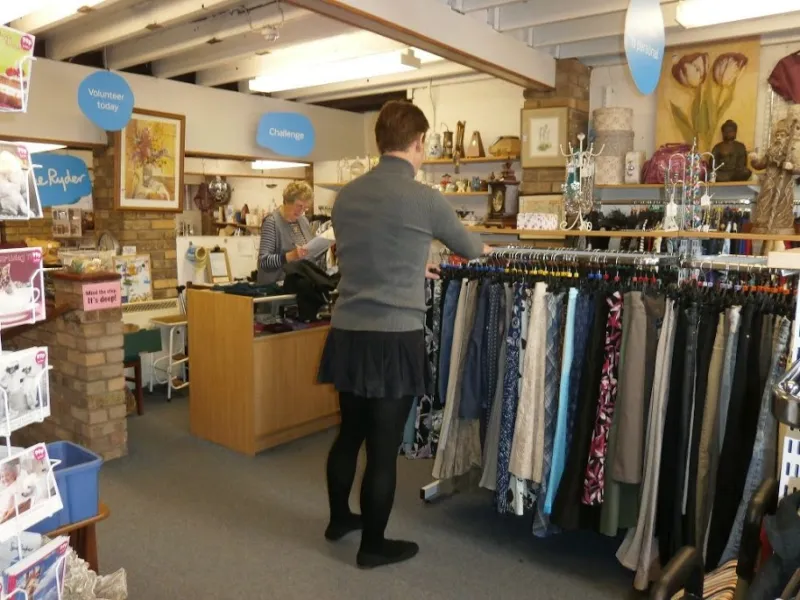
Photo: Hugofocus, CC BY-SA 4.0, via Wikimedia Commons
There is a particular sound a charity shop makes in mid-November. It is not the tinkle of the doorbell, though that runs all day. It is the soft, repeated thump of bags being dropped behind the counter, one after another, until the floor disappears under Bin Bags of Good Intentions.
On the Broadway, the hospice shop has three volunteers on the till by 11am and a queue that snakes past the greetings cards. Around the corner, the children’s charity shop has a sign taped to the door: Donations 9.30–4.30 only, please — no bags left overnight. It is polite. It is also there because someone left a bag of damp towels in the rain last Tuesday and nobody wants to say it too loudly.
I spent a week asking the simple question that most of us never ask: what actually happens after the bag is handed over?
Monday: the coat that arrived without a story
The first bag of the week contains a navy wool coat. Good label, slightly shiny at the elbows, one button missing, a crumpled tissue in the pocket and a bus ticket from 2019. It is the sort of coat that could go three ways: the rail, the rag sack, or the bin.
At the hospice shop, the manager — let’s call her Elaine, because she has asked me not to make her sound like a corporate case study — holds it up to the window light. “Wool, that. Real wool. You can feel it.” She checks the lining, the armpits, the cuffs. The missing button is not a dealbreaker; there is a tin of spare buttons in the back room that has been quietly growing since the shop opened.
By Tuesday it will be steamed, rebuttoned, priced at £12 and on a rail near the front, labelled “Vintage wool — small mark on cuff, priced accordingly.” That label matters. It is the difference between a shopper feeling tricked and a shopper feeling like they have found something.
The tissue goes in the bin. The bus ticket goes in the bin too, though Elaine admits she sometimes keeps the odd note or photograph for a week, just in case someone comes back for it. “They never do,” she says. “But you don’t want to be the one who threw away somebody’s nan.”
Tuesday: the paperbacks with a dedication inside
A box of paperbacks arrives from a house clearance on Fortis Green. Forty-one books, mostly 1990s thrillers, two cookbooks, a dictionary, and a copy of a wartime memoir with “To Dot, with love, Christmas 1987” written inside.
The books go through a quick triage. Anything mouldy, water-damaged or missing a spine goes to the recycling sack — charity shops cannot sell damp paper, and they will not try. The rest are wiped, checked for pencil marks, and priced at 50p or £1. The memoir goes on the “local interest” shelf, not because it is worth more, but because someone in N10 might recognise the name.
This is the part of charity retail that surprises people most: the sorting is not about value, it is about likelihood. Will this sell in this shop, on this street, in the next three weeks? A hardback biography of a forgotten politician will sit for months. A clean copy of a bestselling thriller will go by Saturday. The shop is not a museum. It is a shop.
What does not sell within a few weeks goes into the next tier: other branches, a specialist book buyer, or the recycling stream. Nothing is meant to sit forever. The back room is not a warehouse; it is a holding pen with a clock on it.
Wednesday: the teapot without a lid
The odd crockery arrives in a washing-up bowl: six mismatched mugs, a teapot with no lid, three side plates and a gravy boat. The mugs are fine — they will be bundled as a “kitchen starter set” for £2. The side plates will go with the mugs. The gravy boat is a maybe; it depends on whether the volunteer on the bric-a-brac table is feeling optimistic.
The teapot is the interesting one. No lid, slight chip on the spout, pretty pattern. It cannot be sold as a teapot. It could be sold as a planter, but someone has to write the label and find the right shelf. In the end it goes into the “craft and upcycle” box, which is a polite name for the things that might become someone else’s project.
This is where the charity shop economy gets quietly ruthless. Textiles that cannot be sold are weighed and sold to rag merchants by the kilo. Broken electricals are tested and, if unsafe, recycled. Bric-a-brac that nobody wants becomes landfill, and every shop I spoke to hates that part of the job. “We are not a tip,” one volunteer says, not unkindly. “But we end up being the last stop before one.”
Thursday: the rail refresh
By Thursday, the front of the shop has changed. The navy coat is on a mannequin near the door with a scarf that arrived in the same bag. The paperbacks are faced out, covers forward, because covers sell books. The mugs are stacked in a pyramid on the counter, next to a handwritten sign: “50p each or £2 for the lot — help us clear the shelf.”
There is a small ritual to the rail refresh. Everything that has been out for three weeks gets pulled to the back. Anything with a mark gets re-priced. Anything that has not moved gets moved. The shop is not just selling your donations; it is curating them, hour by hour, in a space the size of a generous living room.
And the money? It goes to the cause on the door. Hospice care, children’s services, animal rescue — the specific charity matters less than the principle. A £12 coat, a £1 paperback, a £2 mug set: these are small sums that add up to something real. The back room is where the maths happens. The front room is where the neighbours make it possible.
Friday: the window
On Friday afternoon, the Christmas window goes in. Not the full tinsel explosion — that comes later — but the first pass: a fake tree, a rail of party dresses, a shelf of pristine cookbooks, a sign that says “Gifts under £5”.
The navy coat is still there. It has been tried on twice and put back once. Elaine is not worried. “It’ll go,” she says. “Coats always go when the weather turns.”
She is right. By Saturday lunchtime, it has gone.
What the bag doesn’t say
So what does a good donation look like in 2026? The volunteers I spoke to were remarkably consistent.
- Donate during opening hours. Bags left outside get damp, stolen or ruined. The shop cannot sell what has been rained on.
- Wash and check. Empty the pockets. Zip the zips. Put buttons and belts in a bag with the garment. A missing button is fine; a mystery stain is not.
- Ask about Gift Aid. If you are a UK taxpayer, signing up can add 25% to the value of your donation at no extra cost to you.
- Be honest about electricals and safety. If it does not work, say so. If it is broken, recycle it properly.
- Think about the season. Christmas stock is sorted in October and November. If you want your donations to make the window, get them in early.
- Remember the rag sack. Not everything sells, and that is okay. The shop would rather have your clean, sellable things than a bag of maybes.
On Sunday the shops are shut. The rails sit in the dark, the back rooms smell faintly of steam and cardboard, and the bags wait for Monday. Somewhere in there is a coat, a book, a teapot without a lid. None of them are worth much on their own. Together, they are a neighbourhood quietly funding itself, one thump of a bag at a time.