Pinned, Laminated and Ignored: The Noticeboards That Still Run Muswell Hill
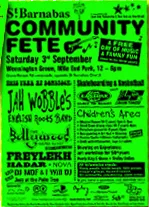
Photo: St Barnabas Community Fete / St Barnabas PCC, CC BY-SA 3.0, via Wikimedia Commons
There is a laminated card on a railing near the top of the Broadway advertising a piano teacher. The tear-off tabs went years ago. The card is still there, slightly faded, entirely unbowed. Nobody has removed it and nobody has complained about it, and that, more or less, is how local information still works in this corner of north London.
We are forever being told that we live in a digital age, that the community group chat has replaced the community, that nobody reads a poster any more. Then you walk past the glass case outside the library on a wet Tuesday and find a handwritten notice about a bereavement café, a photocopied plea for a missing tabby, and a yoga class that has been running since before anyone had a smartphone. So we spent a week reading the boards. All of them. Here is what the paper trail says about us.
A rough taxonomy of the local noticeboard
Muswell Hill's boards are not interchangeable. Each one has its own personality, its own audience and its own unwritten rules.
The big glass-fronted case by the library is the establishment. Council consultations, reading group dates, a volunteer drive for the food bank, the occasional planning notice. It is where official Muswell Hill speaks to itself, and it is possibly the only place in the neighbourhood where a leaflet about bin collection changes will be read by anyone at all.
Church halls and porches come next. St James's, the United Reformed church, the meeting house up the road — these boards are gentler, more handwritten, and considerably more likely to feature a recipe. Their notices do not shout. They assume you already know why you are there, which is rather charming.
Then there is the café layer: the free-card racks by the door, the window cards taped at eye level, the pilates teacher, the guitar lessons, the mobile dog groomer, the childminder with a vacancy from January. This is the most commercial stratum of the paper trail, and also the most up to date. Cafés turn their windows over quickly because a card that has been up for six months looks like a failure.
The supermarket pillar and the launderette are the wild west. Flats to let. Removals. A single glove. A set of keys with a fob and a small wooden heart attached, described in detail, clearly posted by someone who was having a worse day than you are.
And then there is the unofficial layer: the lampposts, the railings, the backs of bus shelters. Stickers, mostly. Band flyers, occasionally. Nobody plans this layer, which is exactly why it tells you the most.
The lost cat economy
Nothing on any of these boards outperforms a missing animal. A photograph, a name, a road reference and a mobile number will be read by more people in a fortnight than most businesses manage in a year. Lost cats dominate, but the close relatives are worth noting: keys, phones, a hearing aid, one earring, and — memorably, last winter — a single child's welly, described as though it might be persuaded to return of its own accord.
The lost-and-found notice is the purest form of local publishing. There is no product, no pitch, no brand. Just a problem and a phone number. It is also where the boards beat the internet outright: a poster at the right corner gets seen by the exact people who walk that street every day.
Why paper still holds
Three reasons, and none of them are sentimental.
The first is reach. Not everyone is in the group chat. Some people have left it deliberately. Some never joined. Some are eighty-six and would rather not. A board is one of the last genuinely mixed-age, mixed-income, no-login-required spaces left in the neighbourhood.
The second is accountability. A printed notice with a name and a phone number attached feels like a person standing behind a claim. That is a higher bar than a post in a group of four thousand strangers.
The third is noise. Digital local life is fast and loud and largely reactive — someone complains, others pile in, the thread vanishes by Thursday. A board is slow and quiet and oddly archival. It does not demand your attention. It waits.
What the boards cannot do is stay tidy. Anything unlaminated and untaped is mulch by the second week of November. Sticky notes do not survive. A5 with tear-off strips at the bottom works. Anything requiring a QR code gets scanned roughly half the time, which is still better than nothing. Big type beats clever type every single occasion.
The unwritten etiquette
There are rules, and everyone seems to know them without being told. One card per board. Never cover someone else's notice, even if it has clearly expired. Date your event so readers can tell whether it has already happened. Don't tape outside the frame. And take the thing down yourself when it is over, because nobody else will and the piano teacher will still be there in three years.
A practical map for the offline-curious
If you want to read local news the slow way, start with the library case, which is the closest thing we have to a public record. Then walk the Broadway and read the café windows — that is where the newest information lives. Church porches if you want the civic and the domestic in one place. The supermarket pillar if you want to know what is actually happening on your street, including things nobody would put in a newsletter.
If you want to post something, do this: write it at A6, laminate it, put the date on it, lead with the plainest possible description of what it is, and include a name rather than a company. Tear-off tabs still work, despite what you may have heard. Then take it down afterwards, which is the whole of the etiquette, really.
The boards are not a relic and they are not a billboard. They are a slow conversation between people who share a few streets, a couple of bus routes and a tendency to lose gloves. Long may they stay pinned.