Buggy Traffic, Borrowed Kerbs: The Daily Puzzle of Muswell Hill’s Pick-Up Hour
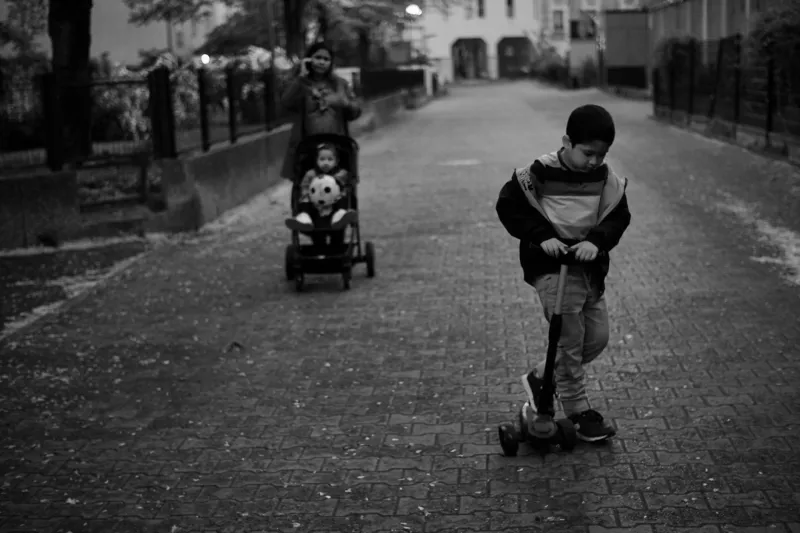
At 3.10pm, the Broadway still looks like the Broadway. Buses pull in, someone queues for a coffee, a delivery bike threads between bollards. By 3.20pm, the pavement has changed job. It is no longer just a place to walk. It is a waiting room, a meeting point, a buggy park, a scooter lane and — for a few cramped minutes — a place where nobody quite has enough room.
This is the pick-up hour in Muswell Hill: not a single event, but a hundred small arrivals happening at once. Parents and carers come on foot, by bus, by car and by bike. Children come out buzzing or weary. Shopkeepers watch the tide rise past their doors. Nobody is doing anything wrong. The friction comes from the fact that a Victorian pavement is being asked to do a twenty-first-century job.
The hour when the pavement changes job
The school run gets a bad press, usually framed as a traffic story. Around Muswell Hill, it is more useful to see it as a choreography problem. The same stretch of pavement has to absorb prams, toddlers, grandparents, dog walkers, café tables, bin day and the occasional A-board. Add a bus stop and a dropped kerb in the wrong place, and the whole thing snags.
The pinch points are not mysterious. They are the familiar places where the pavement narrows just as two streams of people meet: the busy stretch near the Broadway crossings, the corners where parked cars push everyone towards the kerb, and the short walks between school gates and the main road. At 3.15pm, a single double-parked car can turn a clear pavement into a slalom.
What is striking is how politely most of it is negotiated. Buggies angle sideways. A dog is shortened on the lead. A scooter is lifted. Someone holds a door. The daily shuffle is full of tiny acts of patience — but patience has a limit when it is required every single day.
Where it snags: a rough map
The first bottleneck is the school gate itself. Schools are not designed as drop-off hubs, and most gates open directly onto residential streets. That works beautifully for five minutes and badly for fifteen. Parents arriving early cluster; parents arriving late hurry; children spill out in waves. The pavement outside becomes a social space and an obstacle course at the same time.
The second is the Broadway. It is the natural meeting point for families splitting off in different directions, and the natural place for a quick shop or a chat. But it is also where the widest range of pavement users collide: bus passengers, shoppers, school groups, buggies and people navigating kerbs. The issue is rarely one group. It is the combination.
The third is the borrowed kerb. When pavements feel too tight, people step into the road. Usually it is brief and careful. But on a damp November afternoon, with visibility dropping and cars edging out of side streets, those borrowed kerbs matter. A clearer crossing point, a longer green man or a bit more space at the corner would do more than any lecture about walking to school.
Shopkeepers: not anti-pram, anti-blockage
Talk to businesses on the Broadway and you rarely hear hostility towards families. You hear something more practical: doorways. A shop can cope with a busy pavement. It struggles when a pram, a buggy and a group of adults stop directly outside the entrance while a coffee is collected or a chat finishes. The complaint is not about children. It is about access.
The same goes for buses. A stop blocked by parked cars or crowded by waiting buggies becomes harder for everyone, including people with mobility aids and parents travelling alone. The school run is not separate from the high street. It is one of the high street’s busiest shifts.
What would actually help
There is no single fix, and that is probably the point. The most useful changes are small and unglamorous.
Clearer kerbs would help: dropped kerbs that are not blocked by parked cars, bins or temporary signs, and crossing points that feel safe enough for a child on a scooter. Kinder crossings would help too — slightly longer crossing times at peak hours, better sightlines at corners, and maybe a second look at how the busiest junctions handle school-hour foot traffic.
A walking bus is another practical idea. Parent-led, volunteer-run and simple, it takes a few cars off the school gate without asking every family to reorganise their lives. Park-and-stride schemes can work in the same spirit: park a little further out, walk the last ten minutes, reduce the crush at the gate.
Staggered collection times are already used by some schools and could ease the sharpest peak. So could a simple, well-publicised map of the pinch points — not to shame anyone, but to help families choose a slightly quieter route or meeting point.
The small wins are already visible
None of this requires a grand redesign. On some streets, a bit of paint and a clearer crossing would do it. On others, the answer is social: parents agreeing to meet a street away, shopkeepers keeping doorways clear, schools reminding families that the pavement is shared with neighbours.
The pick-up hour is one of the most human parts of Muswell Hill. It is noisy, messy and occasionally infuriating, but it is also a daily reminder that the neighbourhood is full of people looking out for each other. The task is not to clear the pavements of children. It is to make a little more room for the lives already there.